The Wellness OS: Why High-End Clubs Are Becoming Beautiful Liabilities
Are you building a luxury wellness club? A beautiful design without a robust Operating System is a commercial disaster. Learn how to align Gym, Spa, and Social zones for maximum ROI.
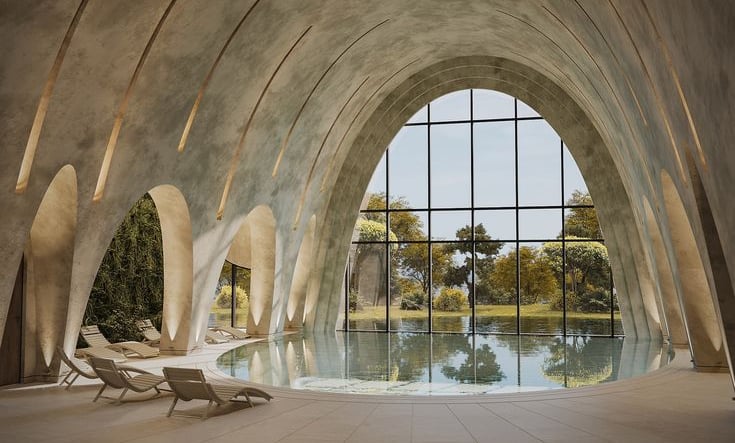
The era of the standalone spa has ended. The market has shifted aggressively toward the Integrated Wellness Ecosystem: a seamless fusion of high-performance fitness, clinical recovery, holistic spa, and social hospitality.
Developers are chasing this trend. We are seeing a boom in private members' clubs and "Urban Resorts" that promise to be the "Third Place" for high-net-worth individuals. The Global Wellness Institute reports that wellness real estate is the fastest-growing sector in the industry, yet it remains the most operationally complex.
Why? Because merging a high-energy gym, a silent spa, and a bustling café under one roof is an operational minefield.
When these distinct energy zones collide without a strategy, you don't get a lifestyle hub. You get a "Beautiful Liability."
The Zoning Clash: When High Energy Meets Low Frequency
In a single-use facility (like a standalone spa), the operational flow is linear. In a multi-modality wellness club, the flow is a complex web.
The most common failure we see in "concept-first" designs is the lack of acoustic and vibrational zoning.
We recently audited a luxury wellness club where the "Mindfulness Studio" shared a structural slab with the "Performance Zone" (heavy lifting).
The Result: Every deadlift drop sent a vibration through the floor of the meditation class.
The Member Experience: Broken immersion.
The Commercial Impact: The studio classes (a high-margin retention tool) were constantly complained about and eventually under-attended.
This is a failure of the Wellness Operating Model (OS). The design looked cohesive on a floor plan, but the operational reality was disjointed.
Explore our Commercial Wellness Asset Services
The "Frankenstein" Tech Stack
A seamless member journey requires a seamless digital backbone. However, most clubs are built with a "Frankenstein" tech stack:
A PMS for the hotel/club access.
A booking engine for the Spa treatment rooms.
A separate app for Gym class scheduling.
A standalone POS for the Wellness Café.
The Friction: A member finishes a HIIT class and wants to book a cryotherapy session and order a smoothie. If they have to interact with three different staff members or apps to do this, you have lost the "luxury" status.
The Fix: A unified Wellness OS integrates these verticals. It allows the F&B team to know exactly when a high-value member finishes their personal training session, ensuring their post-workout nutrition is ready. That is 'Service Architecture', and it drives secondary spend.
The "Empty Box" Syndrome: Recovery & Longevity
Every modern luxury club now includes a "Longevity Hub" or "Recovery Lab": Cryo, Hyperbaric Oxygen, IV Drips, and Infrared Saunas.
These look incredible in an investor deck. They scream "innovation." But operationally, they are often money pits.
Why? Because they are designed as static rooms rather than guided circuits.
If you tuck a hyperbaric chamber in a corner without a clear "Recovery Concierge" workflow, it sits empty. Members are intimidated by the tech or don't know how to use it.
Asset Heavy: You spent $150k on equipment.
Usage Light: Utilization sits at 15%.
Operational Excellence means designing a "Guided Recovery Flow"—a programmed journey where members are moved through these modalities efficiently, often with semi-automated supervision to keep labor costs low while keeping usage high.
The Solution: The Wellness OS Blueprint
To protect Asset Value in a multi-modality club, the operational strategy must dictate the design, not the other way around.
At Luxe Wellness Spaces, we use the Luxe Spaces 360 methodology to harmonize these conflicting zones:
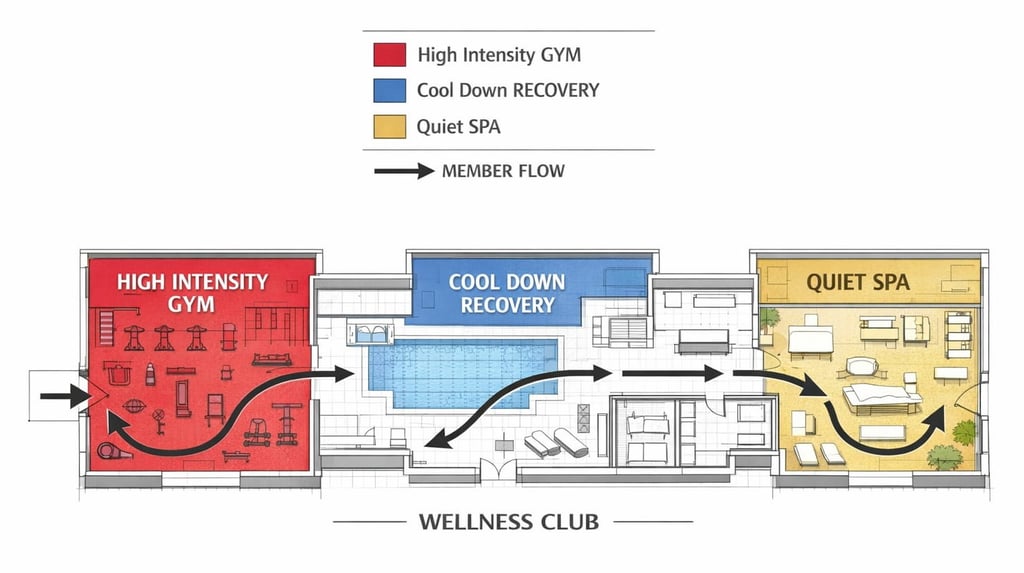
Transition Corridors: We design "airlocks" between high-energy (Gym/Social) and low-energy (Spa/Recovery) zones to manage sound and psychology.
Cross-Utilization Modeling: We map how a single staff member can float between the Recovery Lounge and the Gym floor, optimizing labor efficiency (Payroll is your biggest enemy).
Social Engineering: We place the "Refuel" zones (Café/Lounge) at the convergence point of all traffic, forcing social collision and increasing F&B capture rate.
A beautiful club gets them to sign the contract. A flawless Operating System keeps them paying the monthly dues.
Don't build a facility where the gym users disturb the spa guests, and the café is too far from the locker rooms. Lock in your Wellness OS before you pour the foundation.
Further reading on our blog: Learn 'How Luxury Wellness Spaces Drive Revenue Through Experience Architecture.'
You may also enjoy: Learn what benefits a Spa Consultant can bring to your Strategic Investment for Wellness.
FAQ's
Q: What is the difference between a Spa and a Wellness Club?
A: A Spa is a destination primarily for passive treatments (massage, facials) with a focus on silence and relaxation. A Wellness Club is an integrated ecosystem that combines active fitness (gym, classes), clinical recovery (cryo, IV), social elements (coworking, café), and traditional spa services into a daily lifestyle membership model.
Q: How do you design a gym and spa in the same building?
A: Successful integration requires strict "Acoustic and Vibrational Zoning." High-impact areas (weight lifting, HIIT) must be structurally isolated from quiet zones (meditation, massage). Furthermore, circulation paths should be designed so that sweaty fitness members do not cross paths with robed spa guests, preserving the integrity of both experiences.
Q: What is the most profitable area in a luxury wellness club?
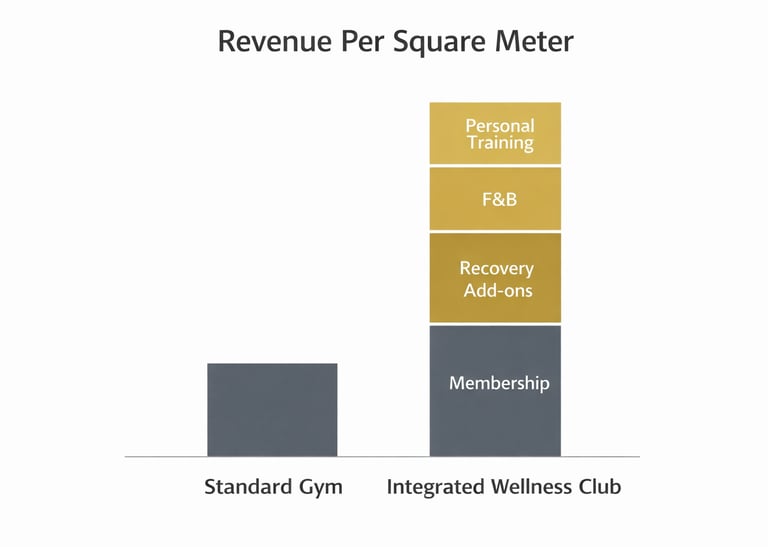
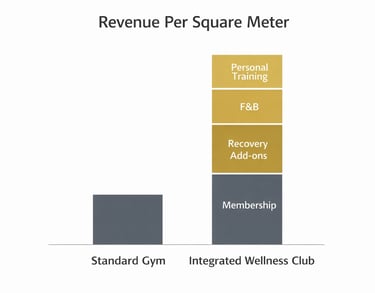
A: While membership dues provide the baseline revenue, the "Recovery" and "Longevity" zones often offer the highest profit margins per square foot. These zones (Infrared, compression, cryo) have low labor costs compared to 1-on-1 personal training or massage, allowing for scalable "semi-automated" revenue.
Q: Why is F&B important in a wellness club?
A: Food and Beverage is the "Social Glue" of a wellness club. A well-placed wellness café increases "Dwell Time" (how long a member stays), creates a sense of community, and significantly increases the average revenue per member through secondary spend.
Turning wellness concepts into commercial realities.
© Luxe Wellness Spaces 2026. All rights reserved.


Regional Expertise