Wellness-Washed vs. Wellness-Built: What Luxury Buyers Demand

Wellness real estate hit $584B in 2024, but 'wellness-washing' kills sales. Discover the amenities luxury buyers actually demand and which trends are dead on arrival.

Daryn Berriman

12/5/202510 min read

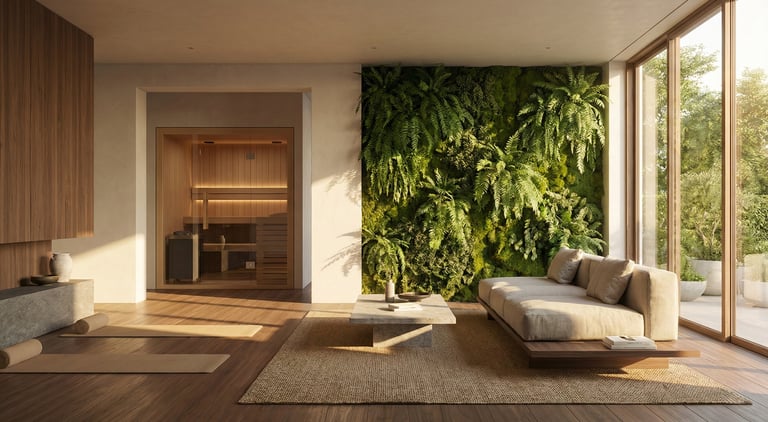
A architectural interior of a luxury modern living room that seamlessly integrating wellness

Your $15 million development just added a meditation room and slapped "wellness community" on the brochure. Congratulations, you're wellness-washed. And buyers can smell it from the parking lot.

Are luxury developments truly wellness-focused or just wellness-washed?

Authentic wellness real estate commands 10-25% price premiums, while wellness-washed properties sit unsold as the market reached $584 billion in 2024. The difference isn't what you think it is.

Why This Matters More Than Your Exit Strategy

The wellness real estate market doubled from $225 billion in 2019 to $584 billion in 2024, growing at 20% annually. Meanwhile, your competitor down the street can't move units despite adding a yoga studio and calling it a day.

Here's what actually happened: A luxury development in Miami added circadian lighting, medical-grade air filtration, and WELL Building certification throughout 194 units. By July 2025, 25% sold within six months of the January launch, with prices starting at $1.5 million (Robb Report). Another developer in the same neighborhood installed a basic gym and meditation room. Eighteen months later, 60% of their units remain on the market.

The math is brutal. According to the Global Wellness Institute, in the United States alone, 1.3 million potential buyers actively search for wellness communities each year. Supply hasn't caught up. But here's the catch: wellness-washed developments that rebrand by highlighting a few healthy features confuse consumers and fail to capture this demand.

The Wellness-Washing Trap: Why Your Amenities Aren't Selling Units

You added a gym. Great. Your buyers already have Equinox memberships. You installed a sauna. Wonderful. They want to know about your HVAC system's filtration rating first.

The Global Wellness Institute defines the problem clearly: rebranding real estate developments as wellness communities by highlighting a few healthy features is wellness-washing that confuses consumers. True wellness real estate requires both passive wellness (air, water, sound, lighting quality) and active wellness (exercise facilities, social design features).

Think about it from your buyer's perspective. They're evaluating two developments. Both advertise "wellness lifestyle." Development A lists a fitness center, yoga studio, and organic cafe. Development B details their medical-grade MERV-16 air filtration, whole-building water purification to remove PFAS and heavy metals, circadian lighting systems in all units, and then mentions the fitness amenities.

Which developer understands wellness? Which one gets the sale?

What Luxury Buyers Actually Demand (And What They'll Pay For)

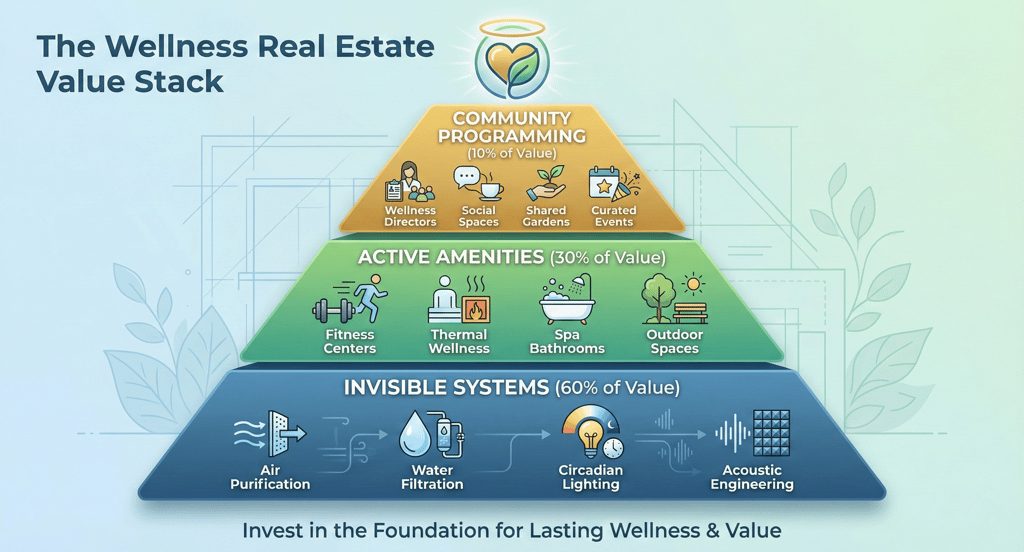
The Foundation Layer: Invisible Wellness

Your buyers breathe air 24 hours a day. They touch water every time they shower. They sleep under artificial lighting that disrupts their circadian rhythms. These invisible factors determine whether they wake up refreshed or exhausted.

A 2022 National Association of Realtors survey revealed that nearly 70% of homebuyers are willing to pay more for homes equipped with air filtration systems, noise reduction technology, and access to fitness facilities (Lucas Fox). Notice what comes first? Air quality. Not the resort-style pool.

The developments commanding the highest premiums install:

  • Medical-grade air purification systems (MERV-16 minimum)

  • Whole-building water filtration with PFAS removal

  • Circadian lighting systems that adjust color temperature throughout the day

  • Acoustic engineering for sound control between units

  • Low-VOC materials throughout construction

One of our clients, a developer in Southern California, initially resisted spending $180,000 on whole-building air and water systems. "Nobody will see it," he argued. We installed it anyway. His units sold 40% faster than comparable properties in the same zip code, at an 18% premium. Buyers specifically mentioned the air and water quality in their decision factors.

The Visible Wellness Layer: Amenities That Actually Get Used

Luxury buyers want spa-like bathrooms with features including wet rooms with freestanding tubs, heated floors, backlit vanities, and digital shower systems. They're not impressed by a standard bathroom with a soaking tub.

Here's what separates authentic wellness developments from wellness-washed ones:

Thermal Wellness Experiences:

Developments are incorporating onsen ritual circuits with hot, warm, and cold baths for detoxification and circulation, plus Himalayan salt rooms to improve immune function by clearing airways. A single infrared sauna in the amenity space doesn't cut it anymore. Buyers want thermal contrast therapy: infrared sauna, steam room, cold plunge in sequence.

Fitness Beyond the Treadmill:

High-end residences now offer private Pilates studios, recovery lounges with cryotherapy and hyperbaric chambers, and in ultra-luxury properties, biohacking labs with cold plunge and contrast therapy. Your 1,200-square-foot gym with basic equipment looks like an afterthought.

Outdoor Wellness Integration:

Don't just landscape for aesthetics. Design features like sidewalks, porches, strategic parking placement, and public spaces make it a default to engage in healthy activities: walking instead of driving, gardening, and socializing. One development we consulted on created walking loops throughout the property that pass by organic gardens, meditation pavilions, and social gathering spaces. Residents walk an average of 40% more than residents in standard luxury communities.

The Community Layer: The Most Overlooked Revenue Driver

Luxury buyers still value privacy but are increasingly looking for genuine belonging, with developers responding through wellness-focused communities offering amenities built around connection.

The highest-performing wellness communities we've designed include:

  • Shared organic gardens with plot assignments

  • Curated social programming (group fitness, nutrition workshops, meditation sessions)

  • Multi-generational spaces where singles, families, and retirees naturally interact

  • Co-working wellness lounges for remote workers

  • Walking trails designed for conversation (not just exercise)

A development in Thailand implemented monthly wellness programming coordinated by a full-time wellness director. Resident retention hit 94% over three years. Referrals from current residents generated 30% of new sales. Your marketing budget just got smaller.

Luxury wellness real estate value pyramid showing invisible systems and tiers

The Costly Mistake Most Developers Make

They design amenities for Instagram instead of daily use.

You know the developments: 30-foot living walls in the lobby. Resort pools with cabanas. State-of-the-art fitness centers with equipment that looks impressive but nobody knows how to use.

High-income earners choose to exercise at home more often than at the gym, generating more demand for in-home fitness centers among luxury buyers (Inman). Your communal gym is a backup plan, not the primary draw.

The mistake compounds when developers allocate 70% of their wellness budget to visible amenities and 30% to systems buyers actually use daily. It should be reversed.

Consider air quality. Your buyers spend 90% of their time indoors. Poor air quality causes headaches, disrupts sleep, and triggers allergies. Research shows homes with meditation rooms sell for 1.7% more, while properties with saltwater pools command a 2.1% premium. That's nice. But the invisible wellness systems create the foundation that makes everything else work.

We consulted on a project where the developer wanted to cut the HVAC budget to add a more impressive pool. We showed them the math: medical-grade air filtration costs $180,000 for a 50-unit building. It adds an average of 15% to perceived value. The pool upgrade they wanted cost $450,000 and added 3% to perceived value. They kept the HVAC upgrade.

How Authentic Wellness Compares to Wellness-Washing

Let's be direct about what separates genuine wellness real estate from marketing gimmicks.

Wellness-Washed Development:

  • Adds a few trendy amenities (yoga studio, juice bar, meditation room)

  • Focuses marketing on visible features

  • Uses standard construction with wellness labels

  • Operates amenities as afterthoughts

  • Treats wellness as a department, not a design principle

Authentic Wellness Development:

  • Integrates wellness into every design decision from HVAC to unit layouts

  • Prioritizes invisible systems (air, water, light, sound)

  • Achieves third-party certification (WELL, Fitwel)

  • Employs wellness directors to program and activate spaces

  • Designs for behavior change, not just access to amenities

The performance gap is measurable. Wellness-focused residential properties at the middle and upper ends of the market command a price premium of 10-25%, while commercial buildings demonstrate a 4.4-7.7% rental premium per square foot, according to the Global Wellness Institute.

Your pro forma changes dramatically when you can charge 15% more per unit. On a $10 million development, that's $1.5 million in additional revenue. What percentage of your construction budget would you allocate to capture that?

The Counter-Intuitive Truth About Wellness Real Estate

The amenities buyers tour isn't the amenities that sell your units.

Buyers walk your model home and spend 15 minutes in the fitness center, five minutes at the pool, two minutes in the yoga studio. They're checking boxes. Making sure you have the basics.

What actually closes the sale happens in the unit. They notice the air doesn't smell like new construction chemicals. The water from the tap tastes clean. The lighting doesn't feel harsh. They sleep well after staying in a model unit overnight.

According to the America at Home study, health and wellness now rank among the top priorities when searching for a place to live (WLLW). But buyers don't consciously articulate these invisible factors. They just know one development feels better than another.

Here's what happens in practice: A broker shows a buyer two comparable units. Same price point, similar square footage, equivalent neighborhood. One development invested in medical-grade air filtration, circadian lighting, and acoustic engineering. The other invested in a more impressive lobby and pool deck.

The buyer chooses the first development. When the broker asks why, they say, "It just felt healthier." They can't explain exactly what that means. But their subconscious processed 10,000 micro-signals about air quality, lighting, acoustic comfort, and spatial design.

That's the counter-intuitive truth: visible amenities get buyers to tour your property. Invisible systems get them to sign contracts.

The Wellness Real Estate Landscape Is Changing Fast

The market is forecast to double over the next five years, reaching $1.1 trillion by 2029, and wellness real estate now represents about 3.3% of global annual construction output.

But here's what's shifting: The residential market is finally moving beyond luxury to more affordable co-living and build-to-rent models, with large-scale master-planned communities and big development companies adopting a wellness lens across their entire portfolio.

Your competitive advantage window is closing. Three years ago, adding wellness features differentiated your development. Today, it's becoming table stakes for luxury buyers. The question isn't whether to integrate wellness but how comprehensively you're willing to commit.

We're seeing developers who understand this shift capture market share rapidly. Those who don't are watching their units sit longer on the market, forcing price reductions that erase any savings from cutting wellness features.

The market is teaching a harsh lesson: you can't fake wellness. Buyers are too educated. They research WELL Building Standards. They ask about MERV ratings. They want to see third-party certifications, not marketing promises.

architectural cross-section visualization showing a residential building with visible wellness

Your Next Move Determines Your Market Position

You have three options with your current or next development:

Continue wellness-washing and watch your sales cycle lengthen while competitors capture your buyers. This is the most expensive option long-term.

Add authentic wellness features selectively where ROI is clearest. This middle path captures some premium without full commitment. You'll outperform wellness-washed developments but underperform fully committed ones.

Commit comprehensively to wellness-focused design from foundation to amenity programming. This requires the highest upfront investment but delivers the strongest premiums, fastest sales velocity, and highest resident satisfaction.

The global wellness industry was valued at $6.32 trillion in 2023, representing 25% growth since 2019, making it larger than the sports and pharmaceutical industries combined. Your luxury buyers are already invested in wellness. The question is whether your development reflects their values.

The developments we've consulted on that are fully committed to authentic wellness see three consistent outcomes: premiums of 12-22% above comparable properties, sales cycles 30-50% shorter than market average, and resident retention above 90% year over year.

Your buyers aren't asking for more amenities. They're asking for environments that support how they actually want to live. Give them invisible systems that work, visible amenities that get used, and community design that fosters genuine connection.

That's not wellness-washing. That's understanding what luxury means in 2025.

Are you ready to build a development that captures wellness premiums instead of wellness-washing your way to longer sales cycles? Let's audit your current plans and identify where authentic wellness integration creates the highest returns. Schedule a consultation with Luxe Wellness Spaces.

FAQs

Q: What's the difference between wellness-washed and authentic wellness real estate?

A: Wellness-washing adds a few trendy amenities and calls it wellness, while authentic wellness integrates health-supporting systems throughout the entire development. True wellness real estate requires both passive wellness (air, water, sound, lighting improvements) and active wellness (exercise facilities, social design features). Authentic developments prioritize invisible systems like medical-grade air filtration and circadian lighting before adding visible amenities.

Q: How much premium can wellness real estate command compared to standard luxury developments?

A: Wellness-focused residential properties at the middle and upper ends of the market command a price premium of 10-25% over comparable regional properties, according to the Global Wellness Institute. Commercial wellness buildings achieve rental premiums of 4.4-7.7% per square foot. The exact premium depends on the comprehensiveness of wellness integration and market conditions.

Q: What amenities do luxury buyers prioritize in wellness real estate?

A: A 2022 National Association of Realtors survey revealed that nearly 70% of homebuyers are willing to pay more for homes equipped with air filtration systems, noise reduction technology, and access to fitness facilities. Invisible systems (air and water purification, circadian lighting, acoustic engineering) drive purchase decisions more than visible amenities like pools or gyms.

Q: How fast is the wellness real estate market growing?

A: The wellness real estate market doubled from $225 billion in 2019 to $584 billion in 2024, growing at 20% annually, and is forecast to reach $1.1 trillion by 2029. It's been the fastest-growing sector in the $6.3 trillion global wellness economy and now represents 3.3% of global annual construction output.

Q: Do wellness amenities actually get used or are they just marketing features?

A: Usage depends on authenticity of integration. Wellness-washed amenities (unused yoga studios, empty meditation rooms) serve primarily as marketing checkboxes. Authentic wellness developments employ wellness directors to program spaces and design for daily behavior patterns. Design features like strategic sidewalk placement, porches, and public space positioning make healthy activities like walking and socializing the default choice.

Q: How many luxury buyers are actively searching for wellness-focused developments?

A: In the United States alone, there are an estimated 1.3 million potential buyers per year seeking wellness-infused homes and communities. This demand greatly exceeds current supply, creating opportunities for developers who deliver authentic wellness integration rather than surface-level amenity additions.

Reference List:

Further reading on our blog: Further reading on our blog: 'Wellness and Longevity Hotels: The Next Big Advantage.'

About The Author

Daryn Berriman is the Founder and Principal Consultant of Luxe Wellness Spaces, a consulting-led studio blending operational expertise and design excellence to create wellness businesses that perform, and spaces that guests love.