Sleep Tourism: The $142B Revenue Opportunity for Hotels
Sleep tourism drives 4-6% GOPPAR increases for hotels. Learn how smart bed technology and wellness rooms command 20-30% ADR premiums. Implementation roadmap included.
Daryn Berriman
11/28/20259 min read
How Sleep Tourism Compares to Traditional Wellness
Traditional spa models operate on:
High variable costs (therapist labor)
Low capacity (one therapist, one guest, one hour)
Inconsistent quality (human performance variability)
Difficult scaling (hiring, training, retention challenges)
Sleep tourism models operate on:
Fixed capital costs (technology, room design)
High capacity (one smart bed serves 300+ annual guests)
Consistent quality (technology-driven standardization)
Easy scaling (replicate design and technology packages)
The margin profile shifts dramatically. Traditional spa treatments might generate 30-40% margins after labor costs. Sleep-enhanced room categories generate 70-80% margins after initial capital recovery.
Properties with wellness features displayed lower GOPPAR volatility, suggesting greater resilience across market cycles. When travel demand drops, wellness-focused properties maintain stronger occupancy through health-motivated bookings less sensitive to economic conditions.
The Counter-Intuitive Truth About Sleep Tourism
The biggest surprise in sleep tourism data: nearly two-thirds of travelers admit to sleeping better when sleeping alone, with 37% of travelers preferring to sleep in separate beds from their partner when traveling.
This contradicts traditional hospitality assumptions about romantic getaways and shared experiences. It creates a massive opportunity that properties are missing.
The confirmed connecting room becomes a premium wellness product. Two guests, two rooms, two separate sleep environments optimized for individual biometrics, shared social time during waking hours. Price it at 170% of a single room rate instead of 140%, and suddenly you're capturing the sleep divorce trend at premium margins.
About 30% of younger travelers (Zillennials) enjoy "Hurkle-Durkling" – the Scottish phrase for intentionally lounging all day in bed while on vacation – compared to only 11% of Gen X and Baby Boomers. This segment wants permission to do nothing. Design packages around guilt-free rest: no scheduled activities, in-room dining optimized for sleep, permission to sleep until 2 PM. Market it as intentional recovery rather than laziness.
Your 90-Day Implementation Roadmap
Months 1-2: Assessment and Quick Wins
Audit existing rooms for sleep quality. Identify your 10-20 best candidates for conversion to Wellness Rooms based on location, noise levels, and current condition.
Partner with a sleep technology vendor. Bryte and Eight Sleep both offer hospitality programs. Negotiate a pilot agreement for 10-15 rooms rather than purchasing outright.
Create your baseline sleep package bundling existing low-tech amenities: blackout curtains, pillow menu, white noise machines, aromatherapy, herbal tea service, late checkout. Price this at 15-20% above standard rates while technology installations progress.
Month 3: Technology Integration
Install smart beds in pilot rooms. Complete staff training on technology features and guest communication. Update property management systems to create the new Wellness Room category.
Develop partnerships with local sleep specialists or functional medicine practitioners. You need credentialed expertise to justify premium pricing and provide guest consultations.
Launch pre-stay sleep assessments. Simple online questionnaires about sleep patterns, challenges, and goals. This data enables personalization and demonstrates your commitment to outcomes, not just amenities.
Months 4-6: Marketing and Scaling
Build marketing campaigns targeting burnout-conscious executives, health-optimizing millennials, and corporate wellness groups. Focus messaging on measurable outcomes and biometric improvement, not just comfort.
Implement post-stay follow-up. Email guests their sleep data with improvement metrics and recommendations for maintaining better sleep at home. This creates recurring booking motivation and referral opportunities.
Based on pilot results, scale to additional rooms. Luxury hotels represent 33.7% of the sleep tourism market in 2025, but the opportunity exists across all categories. Even mid-scale properties can create sleep-focused rooms at lower technology investment levels.
The Geographic Opportunity
North America accounts for 35.3% of market share in 2025, with the U.S. and Canada having well-established medical infrastructure catering to medical tourists. However, growth rates tell a different story.
Top sleep tourism destinations include Kyoto, Santorini, the Amalfi Coast, and the Maldives, with Big Sur, California, leading U.S. destinations. Properties in these locations command premium pricing based on natural tranquility and wellness infrastructure.
For properties outside these established markets, the opportunity is positioning. Johannesburg's Vivari Hotel & Spa won a 2025 World Luxury Hotel Award by integrating medical aesthetics with resort hospitality, pioneering medical tourism in Africa. They didn't wait for their market to mature. They defined it.
Sleep tourism isn't coming. It's here. The question is whether your property will capture premium pricing or watch competitors do it.
Start with your pilot. Ten rooms. Three months. One technology partner. Measure occupancy, ADR, guest satisfaction, and repeat booking rates for your Wellness Room category versus standard rooms.
The data will tell you whether to scale.
But understand this: hotels investing in wellness show measurably better financial performance with lower volatility across market cycles. This isn't a trend play. It's a structural shift in what hospitality means and what guests will pay for.
Your guests are already tracking their sleep with Oura rings, WHOOP bands, and Apple Watches. They're already optimizing for recovery. The only question is whether you'll meet them where they are or continue selling rooms like it's 2019.
Your guests aren't just booking rooms anymore. They're booking rest.
Sleep tourism is projected to be a market valued at over $75 billion in 2024, reaching $142 billion by 2032. For hotel operators and wellness directors, this isn't a trend to watch from the sidelines. Properties investing in wellness amenities achieved a 4-6% GOPPAR increase, with ADR growth averaging 2-3% year-over-year.
The Revenue Reality
Hotels with comprehensive sleep programs command serious premiums. According to 2024 research, 91% of frequent travelers will pay up to 10% more for sleep-enhancing accommodations. More telling: travelers report an average willingness to spend $1,725 specifically for a restful getaway, with 43% ready to pay extra for sleep-enhanced hotel rooms.
This isn't theoretical. Luxury hotels offering major wellness programs delivered approximately 3% higher ADR and 4% stronger GOPPAR compared to properties without these features. Even hotels with minor wellness offerings saw roughly 6% greater profit per available room over the same period.
Why Sleep Became a Premium Product
The data tells a clear story. About 63% of travelers report worse sleep while away, with noise (75%), lighting (72%), and bedding (70%) as top disruptors. Yet over half of the world and two-thirds of Americans actually sleep better in hotels than at home.
This contradiction created an opening. The pandemic shifted wellness from optional to essential. Sleep moved from a basic expectation to a measurable outcome that guests will pay to optimize.
Consider Six Senses' recent launch of their Female Wellness program. The property uses Continuous Glucose Monitors to track guests' blood sugar in real-time during stays, focused on menopause wellness. This isn't a spa menu expansion. It's medical integration commanding five-figure per-person pricing.
The Middle East recognized this faster than most. AMAALA in Saudi Arabia opens in 2026 with properties from Equinox, Clinique La Prairie, Six Senses, Rosewood, Four Seasons, and Ritz-Carlton. Each features subterranean spas, hyperbaric chambers, personalized IV therapies, and sleep-optimized rooms as baseline offerings. They're not competing on thread count. They're competing on biometric improvement.
The Technology Behind Premium Sleep Pricing
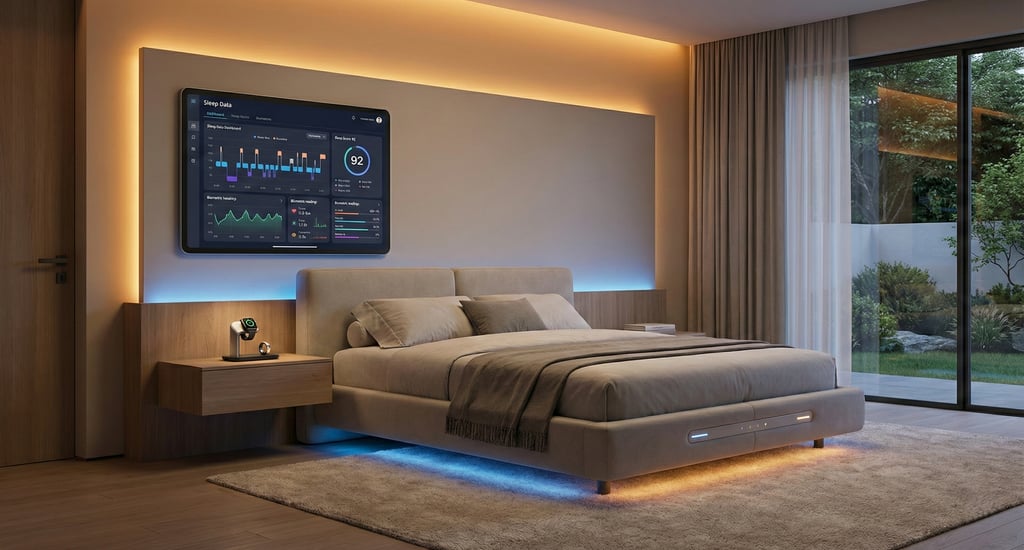
Smart bed technology moved from pilot to profit center. Bryte's Restorative Bed, installed at properties like Carillon Miami Wellness Resort and The London West Hollywood, actively monitors pressure points and provides audio-synced motion to accelerate sleep onset.
Eight Sleep's Pod 5 takes it further with an AI Autopilot that tracks sleep stages and automatically adjusts bed temperature to optimize deep sleep and REM cycles. These aren't amenities. They're revenue categories.
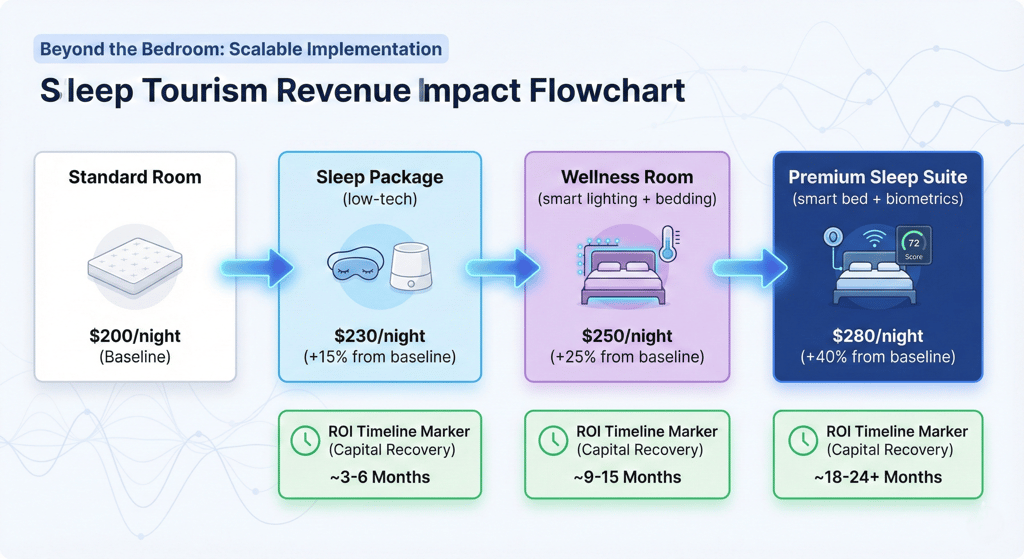
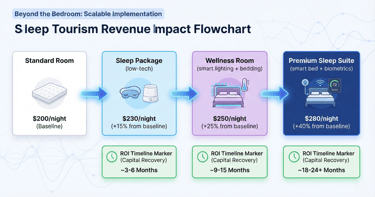
About 70% of luxury travelers now choose hotels based on sleep-centric amenities, including Wellness Rooms. This creates a new premium tier. A standard room costs X. A Wellness Room with smart bed technology, circadian lighting, and air purification costs X plus $150 nightly.
The economics shift from high-friction, variable-cost operations (booking therapists, scheduling treatments) to scalable, high-margin fixed capital expenditures. One smart bed serves hundreds of guests annually at consistent margins.
Circadian lighting follows similar logic. Tunable LED systems mimicking natural sunlight patterns reduce jet lag and improve sleep quality. Properties like Fairmont integrated these as standard in luxury rooms. The upfront cost is fixed. The premium pricing persists indefinitely.
Beyond the Bedroom: Comprehensive Sleep Programming
Leading properties aren't stopping at room upgrades. They're building complete ecosystems.
SHA Wellness Clinic in Spain created a Sleep Well package where Dr. Vicente Mera conducts thorough assessments examining airways, heart function, and neurological systems. Treatment plans include lifestyle modifications, dietary adjustments, supplements, and therapies like CPAP. This is preventative healthcare masked as hospitality.
Soneva's locations in the Maldives offer seven or fourteen-day Soul Sleep Programmes. Post Ranch Inn in California partnered with Dr. Michael Breus, one of America's most renowned sleep experts. Longueville Manor in Jersey brought in psychotherapist and sleep specialist Lydia Falle to create their Sleep Easy experience.
These aren't consultant relationships. They're fundamental business model shifts positioning hotels as accessible entry points to longevity science and preventative medicine.
The Costly Mistake Most Properties Make
Hotels invest in premium mattresses, blackout curtains, and pillow menus, then wonder why guests don't perceive value or pay premiums.
The issue isn't the amenities. It's the lack of measurability and narrative.
Sleep tourism guests don't want features. They want proof. A $500-per-night room needs to demonstrate improvement in their biometric scores. Without measurement, it's just a nice bed. With data showing improved deep sleep, reduced heart rate variability, or better recovery metrics, it becomes a health investment.
Properties installing sleep technology without integrating pre-stay assessments, nightly tracking, and post-stay follow-up miss the entire value proposition. You're not selling comfort. You're selling quantified wellness.
Another mistake: treating sleep programs as spa department initiatives. This requires medical partnerships, data privacy protocols, credentialed wellness directors, and technology integration across property management systems. The organizational structure matters as much as the amenities.

Are you ready to transform your property's revenue through sleep tourism? Luxe Wellness Spaces helps hotel operators and resort developers integrate medical-grade wellness programming that drives measurable ADR increases and GOPPAR growth. Contact our wellness hospitality consulting team to discuss your sleep tourism strategy.
Frequently Asked Questions
Q: How much do hotels need to invest to enter the sleep tourism market?
A: Investment scales by approach. Basic sleep enhancement (blackout curtains, premium bedding, aromatherapy, late checkout) requires $2,000-5,000 per room. Mid-tier technology integration (smart lighting, white noise systems, air purification) adds $5,000-10,000 per room. Premium smart bed technology ranges from $10,000-25,000 per room but commands 20-30% ADR premiums that typically provide 18-24 month payback periods.
Q: Sleep tourism vs. traditional spa offerings – which generates better ROI?
A: Sleep tourism generates superior margins due to fixed capital costs versus variable labor costs in traditional spa models. Traditional spa treatments achieve 30-40% margins after labor expenses. Sleep-enhanced room categories deliver 70-80% margins after capital recovery. Additionally, room-based sleep programs scale more easily than treatment-based spa services limited by therapist availability and capacity constraints.
Q: What's the typical ADR premium for wellness or sleep-enhanced rooms?
A: Market data shows wellness rooms command 15-30% premiums over standard categories depending on technology integration and medical partnerships. Properties with comprehensive sleep programs including biometric tracking, smart beds, and pre/post-stay consultations achieve the high end of this range or exceed it.
Q: How long does it take to see financial results from sleep tourism investments?
A: Quick-win implementations (improved bedding, lighting, aromatherapy packages) show immediate results with 10-15% ADR increases in the first quarter. Technology investments typically achieve positive ROI within 18-24 months. Properties report full capital recovery within 3-4 years while maintaining sustained premium pricing indefinitely.
Q: Do guests really care about sleep technology, or is this industry hype?
A: Consumer behavior validates the trend. 91% of frequent travelers will pay premiums for sleep-enhancing accommodations. 70% of luxury travelers actively choose hotels based on sleep-centric amenities. 43% of travelers will pay extra specifically for sleep-enhanced room experiences. More importantly, properties with these features show measurably higher repeat booking rates and guest satisfaction scores.
Q: What type of staff training is required for sleep tourism programs?
A: Successful programs require three training tiers. Front-line staff need basic sleep technology operation training (2-4 hours). Wellness coordinators or designated sleep specialists require comprehensive training on biometric data interpretation, sleep science fundamentals, and guest consultation techniques (40-80 hours). Medical partnerships with sleep specialists, functional medicine doctors, or certified sleep coaches provide credentialed expertise for premium programs without requiring full-time hires.
Further reading on our blog: Further reading on our blog: 'How Wellness Resorts Are Replacing Itineraries with Immersion.'
Related article: 'Why Analog Wellness Properties Outperform Smart Hotels.'
Explore our Spa & Wellness Consultancy to scope project phases and services.
See how we structure Fitness and Leisure concepts before you commit to equipment.
Learn why Luxe Wellness Spaces blends design, operations, and growth under one roof.
References
Global Wellness Institute - Sleep Initiative Trends for 2025 - Research on traveler willingness to pay premiums for sleep-enhancing accommodations and sleep disruption statistics
HospitalityNet - From Sleep to Profit - HotStats data comparing hotel performance metrics between wellness-focused and standard properties
Amerisleep - Sleep Tourism Survey 2025 - Consumer research on destination preferences and spending patterns for sleep tourism
National Geographic - What is Sleep Tourism - Market size projections and expert insights on sleep tourism growth
Hilton Stories - Sleep Tourizzzm 2.0 - Industry research on traveler sleep preferences and luxury hotel amenity selection patterns
About The Author
Daryn Berriman is the Founder and Principal Consultant of Luxe Wellness Spaces, a consulting-led studio blending operational expertise and design excellence to create wellness businesses that perform, and spaces that guests love.