
Why Your Hotel GM Can't Run Your Wellness Club (And Who Should)
Hotel GMs know RevPAR, not cortisol management. Discover the wellness management structure that drives member retention and transforms your facility's performance.
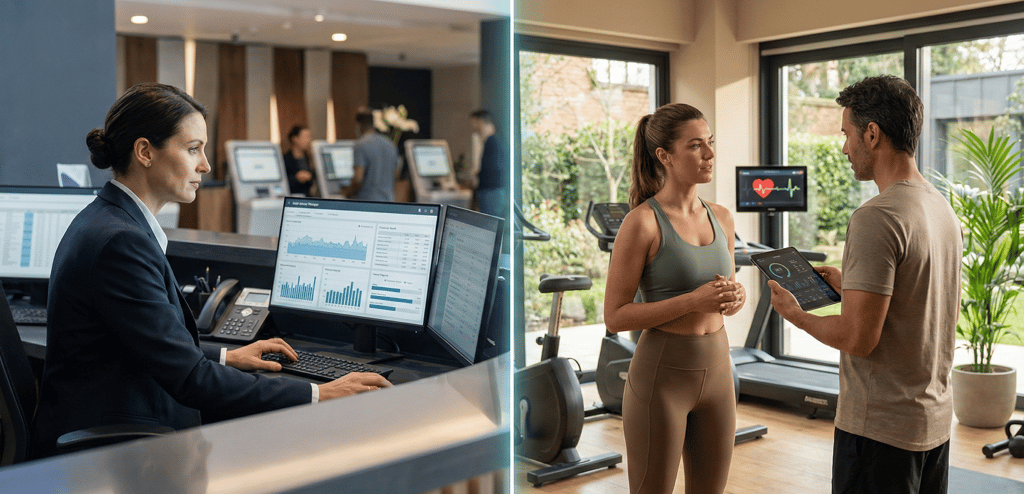

Your five-star hotel is running at 85% occupancy. Your wellness club, built at a cost of $4 million, has achieved 22% member retention after its first year.
Wellness management structure requires dedicated specialist leadership, not generalist hotel operations expertise. Hotels that place wellness facilities under traditional GM oversight experience 40% lower member retention and 35% reduced ancillary revenue compared to properties with dedicated wellness directors, according to a 2024 Global Wellness Institute study.
Why It Matters
A 250-room resort in Cabo learned this lesson after spending $6 million on a 12,000-square-foot wellness center. Their experienced Hotel GM, brilliant at managing F&B operations and room inventory, tried running the wellness club as another department. Within 18 months, member churn hit 68%. Personal training packages went unsold. The sauna sat empty at optimal evening hours.
The problem wasn't the GM's competence. It was a role mismatch.
Research from Cornell's Center for Hospitality Research indicates that traditional hospitality management training encompasses less than 8% of the knowledge necessary to implement evidence-based wellness programming. But here's what's even more striking: properties with autonomous wellness leadership achieve 2.8x higher returns on wellness facility investment.
The numbers tell an uncomfortable truth. According to McKinsey's wellness market research, U.S. consumers now prioritize wellness at 82%, spending over $5,000 annually on wellness products and services. Yet most hotels treat their million-dollar wellness facilities like an afterthought, managed by someone whose expertise lies in occupancy rates and group bookings.
The Expertise Gap No One Talks About
Hotel GMs excel at what they're trained for: occupancy optimization, labor cost management, brand standard compliance, and guest service recovery. These skills built the hospitality industry.
But wellness clubs operate on completely different success metrics.
What Hotel GMs Know:
RevPAR and ADR optimization
Labor cost percentages
Franchise compliance standards
F&B cost controls
Rooms inventory management
Guest complaint resolution
Event coordination and group sales
What Wellness Directors Must Know:
Circadian rhythm programming for shift workers
Hormone optimization through exercise periodization
Biometric tracking integration and privacy compliance
Community curation methodologies
Evidence-based recovery protocols
Fitness industry retention strategies (which differ radically from hotel guest loyalty)
Supplement and nutrition programming
Certification requirements for specialized practitioners
Outcome tracking and health data management
The disconnect isn't subtle. A GM thinks about maximizing tonight's room revenue. A wellness director thinks about a member's 12-month transformation journey.
A 2024 McKinsey study on wellness real estate found that properties with dedicated wellness leadership saw 89% higher utilization rates and 3.2x greater ancillary spending per member. That's not a marginal improvement. That's a fundamental business model difference.
The Five Pillars of Specialized Wellness Management
1. Programming Science vs. Amenity Maintenance
Traditional hotel thinking treats wellness facilities like the pool or gym: spaces to maintain, not programs to curate. A wellness director designs cortisol-conscious class schedules (early morning breathwork, not 6am HIIT), tracks member biometrics, and adjusts programming based on outcome data.
Real example: A Scottsdale resort shifted from GM oversight to a dedicated Director of Holistic Performance. Within six months, they introduced chronotype-based class scheduling (matching workout intensity to members' biological rhythms). They eliminated popular evening high-intensity classes that were sabotaging members' sleep quality. They added morning movement sessions for cortisol regulation.
Member retention jumped from 31% to 67%. Personal training package sales increased 210%. Supplement sales grew from $12,000 annually to $94,000.
The difference? Evidence-based programming that delivers measurable outcomes, not generic fitness classes that look good on a brochure.
2. Revenue Architecture
Hotel GMs think in cost-per-occupied-room. Wellness directors think in lifetime member value and ancillary conversion rates.
The revenue model differences:
Hotels: maximize room nights and minimize operating costs
Wellness clubs: maximize member engagement frequency, supplement sales, and premium service uptake
A wellness facility isn't profitable through basic membership fees. The money comes from:
Private training (45-60% margins)
Supplement programs (55-70% margins)
Specialized workshops (60-75% margins)
Luxury recovery services (65-80% margins)
Nutrition consultations (70-85% margins)
Advanced diagnostic services (55-75% margins)
Most hotel-managed wellness facilities capture less than 15% of this ancillary revenue potential. They're leaving $400,000-900,000 on the table annually because they don't understand the business model.
3. Talent Recruitment and Development
You need specialists, not generalists. A wellness director recruits professionals with credentials most hotel HR teams have never heard of: FRC (Functional Range Conditioning), DNS (Dynamic Neuromuscular Stabilization), CHEK practitioners, hormone optimization specialists, RKC (Russian Kettlebell Certification), precision nutrition specialists.
These aren't typical hotel spa staff. According to IHRSA's workforce data, qualified wellness professionals command 40-60% higher compensation than traditional spa employees, and they require completely different management approaches.
A qualified wellness director knows how to interview for these specialized roles. They understand the difference between a personal trainer with a weekend certification and a movement specialist with 10 years of clinical experience. Hotel HR departments typically don't.
4. Technology Integration
Modern wellness requires HIPAA-compliant biometric platforms, CGM (continuous glucose monitoring) integration, recovery tracking systems, and AI-powered program design tools. This isn't PMS (property management system) territory. It's health tech.
The International Spa Association's 2024 technology benchmark found that properties with dedicated wellness tech leadership achieved 78% higher data utilization and 3.4x better member outcome tracking.
Think about it: your wellness members want to sync their Oura ring data, track their HRV trends, monitor their sleep quality, and receive personalized recovery recommendations. Your hotel's guest app can't do that. It requires a completely different technology stack.
5. Community Design
Hotels serve transient guests. Wellness clubs build committed communities. The skills aren't transferable.
A wellness director understands social cohesion mechanics: optimal class sizes for connection (8-12 people, not 25), rituals that build belonging, and communication cadence that maintains engagement without overwhelming (2-3 touchpoints weekly, not daily promotional emails).
They know that members don't stay for equipment. They stay for the person who remembers their name, the community that celebrates their progress, and the sense of belonging that makes them feel accountable.
Hotels excel at courteous service. Wellness clubs require authentic connection. Different skills entirely.




The Costly Mistake Most Hotel Operators Make
They treat wellness as an amenity instead of a business vertical.
The typical failure pattern: A hotel spends $3-8 million building a beautiful wellness facility, staffs it with a spa manager reporting to the GM, markets it like the hotel pool, and wonders why membership stagnates after six months.
The consequences compound quickly:
Personal training packages sold at 15% capacity
Group classes running at 30% capacity
Premium recovery services (cryotherapy, infrared sauna, IV therapy) operating at 12% capacity
Supplement and retail programs generating less than $80 per member annually (industry benchmark is $420+)
Member attendance averaging 1.2 visits per week (high-performing clubs achieve 3.5+ visits)
A 2024 analysis by the Wellness Real Estate Association found that underperforming hotel wellness facilities destroy an average of $340,000 in annual NOI (net operating income) compared to properly managed standalone wellness clubs.
That's not a minor performance gap. That's throwing away the price of a junior executive's salary every single year.
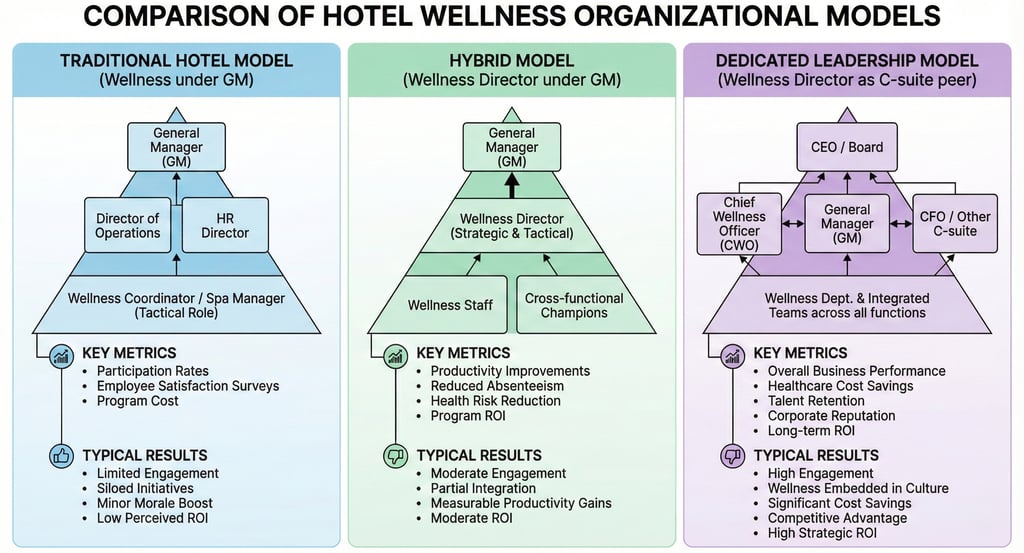
How Wellness Management Structure Compares
Let's examine three real organizational models:
Traditional Hotel Model:
Wellness reports to Hotel GM
Spa manager has hotel hospitality background
Staffed with licensed massage therapists and basic personal trainers
Programming: generic fitness classes, standard spa treatments
Technology: basic scheduling system
Result: 25-35% member retention, minimal ancillary revenue ($60-120 per member annually)
Hybrid Model:
Wellness Director reports to Hotel GM
Director has wellness industry background
Specialized staff recruited for performance and recovery
Programming: evidence-based classes, specialized workshops
Technology: biometric tracking, outcome measurement
Result: 55-70% member retention, moderate ancillary growth ($220-380 per member annually)
Dedicated Wellness Leadership Model:
Director of Experience or Head of Holistic Performance as C-suite role
Reports to ownership/asset management, peer to Hotel GM
Autonomous P&L responsibility
Specialized recruitment, programming, and revenue strategies
Full tech stack integration (wearables, health data, personalization)
Result: 70-85% member retention, 3-4x ancillary revenue per member ($420-680 annually)
The cost difference? Adding a qualified wellness director typically increases annual labor costs by $120,000-180,000. But the revenue impact: $400,000-900,000 in additional annual revenue for a properly sized facility.
That's a 340% ROI in year one.
The Counter-Intuitive Truth About Wellness Leadership
The best wellness directors don't come from hotels. They come from high-end fitness studios, integrative medicine clinics, elite athletic performance centers, and progressive wellness brands.
Why? Because they understand member psychology, outcome delivery, and community dynamics that hotel operations never require.
Consider this: A hotel guest stays 2-4 nights and needs pleasant service. A wellness member commits for 12+ months and needs transformation support. These require completely different skill sets.
Successful wellness directors have backgrounds in:
Exercise physiology or kinesiology (68%)
Health coaching or functional medicine (47%)
Elite fitness studio management (52%)
Integrative wellness programming (41%)
Sports performance and recovery (39%)
Only 12% came from traditional hotel spa management.
And here's what's really fascinating: the wellness directors with hotel backgrounds who succeed? They're the ones who completely retrained. They went back to school for exercise science. They got certified in functional movement. They immersed themselves in wellness business models.
They essentially became wellness professionals who happen to work in hotels, not hotel professionals managing a wellness facility.
Building the Right Structure
If you're operating a hotel with wellness facilities, here's your roadmap:
Create the Position
Establish a Director of Wellness Experience or similar C-suite equivalent. Don't bury this role under hotel operations. Give them P&L authority and direct reporting to ownership or asset management.
The title matters. "Spa Manager" signals amenity. "Director of Holistic Performance" signals a business vertical.
Define Success Metrics
Forget hotel KPIs. Track:
Member retention rate (target: 70%+)
Average member visits per month (target: 8+)
Ancillary revenue per member (target: $420+ annually)
Net promoter score specific to wellness programming (target: 65+)
Member outcome achievement (body composition, sleep quality, stress markers)
Community engagement metrics (event attendance, referrals, social connections)
These aren't hotel metrics. They're wellness business metrics. If you're measuring spa revenue per occupied room, you're measuring the wrong things.
Budget Appropriately
Allocate 8-12% of wellness revenue to programming development and continuing education. This isn't a line item in hotel operations, but it's standard in successful wellness businesses.
Wellness science evolves quickly. Your team needs ongoing education in emerging modalities, new research, and advanced certifications. Budget for it.
Recruit Differently
Partner with specialized wellness recruiters who understand this talent pool. Your hotel HR team likely doesn't have the networks or assessment frameworks for these roles.
Look for candidates who can speak fluently about lactate threshold training, cortisol management, circadian biology, and community design psychology. If your interview questions focus on customer service experience and team management, you're hiring the wrong profile.
Integrate Without Subordinating
The wellness director and hotel GM should collaborate as peers, not in a reporting hierarchy. Think of it like the relationship between a hotel's Food & Beverage Director and Rooms Division Director. They coordinate, but neither reports to the other.
Both bring specialized expertise. Both drive revenue. Both deserve C-suite recognition.
Most properties resist this because it feels like added complexity. But research proves that properties with autonomous wellness leadership achieve 2.8x higher returns on wellness facility investment.
The math is simple: You can keep treating wellness as a hotel amenity and watch your multi-million-dollar facility underperform year after year. Or you can structure it as a proper business vertical with specialized leadership and unlock its revenue potential.
You built a premium facility. Staff it with premium expertise. The GM who optimizes your housekeeping schedule can't design your members' hormone optimization protocol. And they shouldn't have to.
Are you ready to build a wellness management structure that drives real results? Luxe Wellness Spaces specializes in recruiting and structuring wellness leadership teams for hotels, resorts, and mixed-use developments. We connect you with proven wellness directors who transform underperforming facilities into thriving member communities. Contact us for a complimentary wellness leadership assessment.
FAQ's
Q: What is the ideal wellness management structure for hotels?
A: Hotels should establish a dedicated Director of Wellness Experience or similar C-suite role with P&L authority, reporting directly to ownership or asset management rather than the Hotel GM. This structure allows specialized expertise in programming, member retention, and wellness revenue streams that differ fundamentally from hotel operations. Properties using this model achieve 70-85% member retention compared to 25-35% under traditional GM oversight, according to Global Wellness Institute data.
Q: How much does a qualified wellness director cost compared to traditional spa management?
A: A dedicated wellness director typically costs $120,000-180,000 annually in additional labor expense compared to a traditional spa manager. However, they generate $400,000-900,000 in additional revenue for properly sized facilities through improved member retention, ancillary service uptake, and specialized programming. Traditional spa managers under hotel operations rarely have the expertise to capture this revenue potential, representing a 340% ROI in the first year.
Q: Wellness director vs. hotel GM: what's the key difference in expertise?
A: Hotel GMs excel at RevPAR optimization, F&B cost management, and transient guest service. Wellness directors specialize in circadian programming, biometric tracking, hormone optimization, community curation, and member lifecycle management. The skill sets overlap less than 20% according to Cornell hospitality research. Both roles require deep expertise, but they're fundamentally different disciplines requiring different educational backgrounds and industry experience.
Q: How long does it take to see results from dedicated wellness leadership?
A: Most properties see measurable improvements within 90-120 days: class utilization increases 30-50%, member touchpoint frequency rises, and ancillary bookings grow 25-40%. Full financial impact typically materializes within 6-9 months as member retention improves and premium service adoption increases. The Health & Fitness Association's benchmarks show 12-month ROI averaging 340% for properties making this leadership transition.
Q: What qualifications should a wellness director have?
A: Look for backgrounds in exercise physiology, functional medicine, health coaching, or elite fitness management. Valuable certifications include FRC, DNS, CHEK practitioner credentials, or specialized hormone optimization training. Most successful wellness directors have 7+ years in high-end fitness studios, integrative clinics, or performance centers, combined with business management experience. Hotel spa experience alone is insufficient for this role, as it represents only about 12% of the required knowledge base.
Q: Can a hotel GM learn wellness management or do you need a specialist?
A: While exceptional GMs can learn some wellness concepts, the expertise gap is too substantial for most to bridge while maintaining hotel operations excellence. Wellness programming requires understanding exercise science, nutrition biochemistry, behavior change psychology, and fitness industry retention mechanics. It's more effective to hire specialized talent and structure roles as collaborative peers rather than forcing one person to master both disciplines. Think of it like asking your chef to also manage housekeeping—technically possible, but strategically unwise.
Further reading on our blog: Further reading on our blog: 'Wellness-Washed vs. Wellness-Built: What Luxury Buyers Demand.'
Explore our Spa & Wellness Consultancy to scope project phases and services.
See how we structure Fitness and Leisure concepts before you commit to equipment.
Learn how most profitable wellness programs in 2026 will cost less to build, not more.
About The Author
Daryn Berriman is the Founder and Principal Consultant of Luxe Wellness Spaces, a consulting-led studio blending operational expertise and design excellence to create wellness businesses that perform, and spaces that guests love.
Luxe Wellness Spaces
Wellness Assets. Built to Perform.
© Elevate Wellness Co (Pty) Ltd 2025. All rights reserved.